病毒传播模拟:多智能体系统与时空可视化引擎
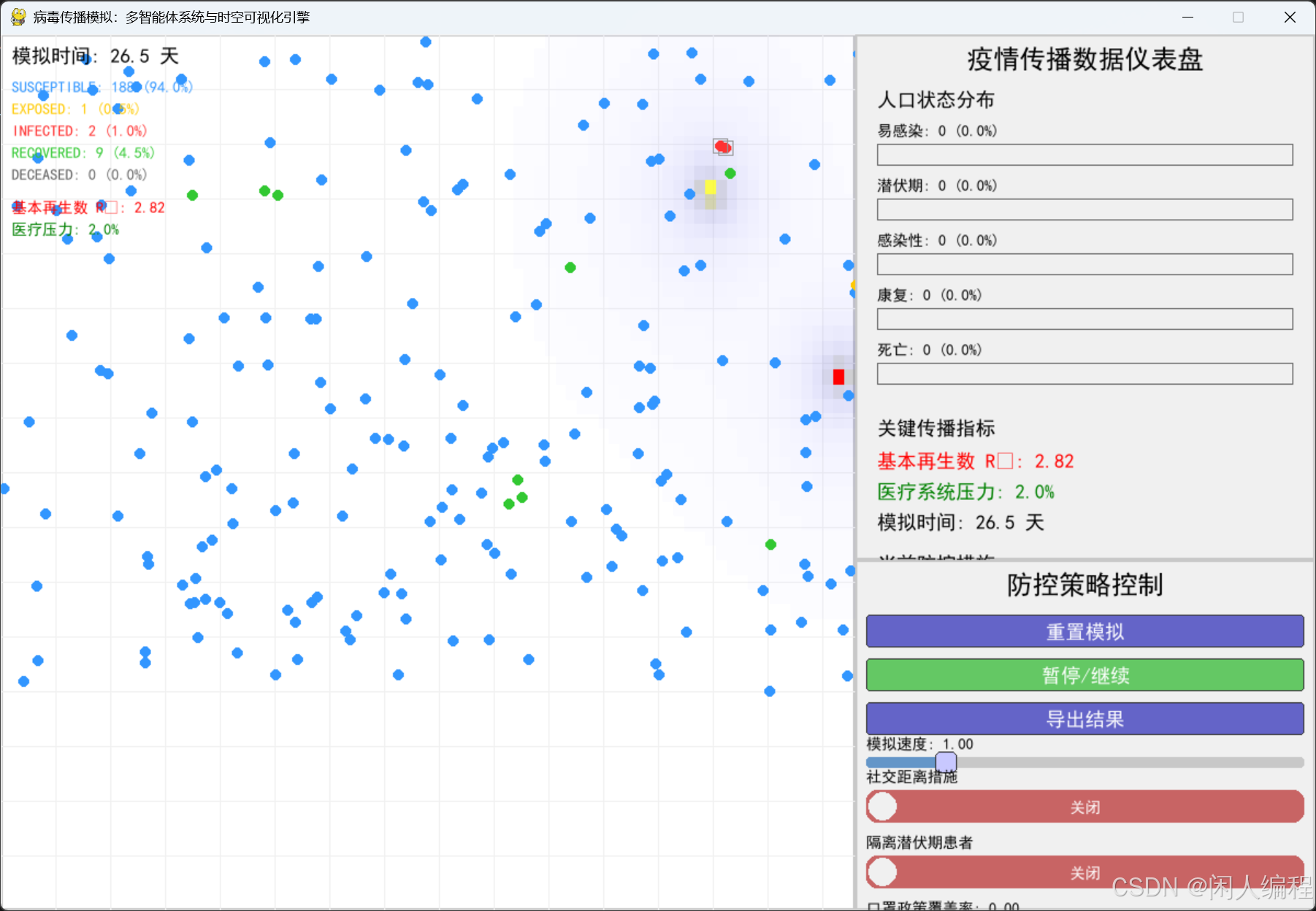
本设计构建了一个融合流行病学模型、个体行为决策和多维可视化的病毒传播沙盒系统。通过建立多层传播网络与实时数据映射,实现从微观个体互动到宏观传播趋势的全链路模拟。
目录
病毒传播模拟:多智能体系统与时空可视化引擎
需要源码请+V:xrbcgfh0214
引言
本设计构建了一个融合流行病学模型、个体行为决策和多维可视化的病毒传播沙盒系统。通过建立多层传播网络与实时数据映射,实现从微观个体互动到宏观传播趋势的全链路模拟。
第一章 传播动力学模型
1.1 扩展SEIRD模型
{ d S d t = − β S I N d E d t = β S I N − σ E d I d t = σ E − γ I d R d t = γ I ( 1 − μ ) d D d t = γ I μ \begin{cases} \frac{dS}{dt} = -\beta S\frac{I}{N} \\ \frac{dE}{dt} = \beta S\frac{I}{N} - \sigma E \\ \frac{dI}{dt} = \sigma E - \gamma I \\ \frac{dR}{dt} = \gamma I (1 - \mu) \\ \frac{dD}{dt} = \gamma I \mu \end{cases} ⎩ ⎨ ⎧dtdS=−βSNIdtdE=βSNI−σEdtdI=σE−γIdtdR=γI(1−μ)dtdD=γIμ
参数说明:
- β \beta β: 接触感染率
- σ \sigma σ: 潜伏转化率
- γ \gamma γ: 康复率
- μ \mu μ: 病死率
1.2 空间传播网络
构建双层传播网络:
第二章 群体行为建模
2.1 个体移动模式
改进的随机游走模型:
Δ x = v cos θ + D ξ x \Delta x = v\cos\theta + D\xi_x Δx=vcosθ+Dξx
Δ y = v sin θ + D ξ y \Delta y = v\sin\theta + D\xi_y Δy=vsinθ+Dξy
其中 D D D为社交距离影响因子
2.2 行为决策树
第三章 可视化系统设计
3.1 实时热力图生成
反距离加权插值算法:
I ( x , y ) = ∑ w i I i ∑ w i , w i = 1 d i p I(x,y) = \frac{\sum w_i I_i}{\sum w_i}, \quad w_i = \frac{1}{d_i^p} I(x,y)=∑wi∑wiIi,wi=dip1
3.2 传播网络图
力导向布局动力学方程:
{ x ¨ i = k ∑ ( ∥ x j − x i ∥ − l ) x j − x i ∥ x j − x i ∥ y ¨ i = k ∑ ( ∥ y j − y i ∥ − l ) y j − y i ∥ y j − y i ∥ \begin{cases} \ddot{x}_i = k \sum (\|x_j - x_i\| - l)\frac{x_j - x_i}{\|x_j - x_i\|} \\ \ddot{y}_i = k \sum (\|y_j - y_i\| - l)\frac{y_j - y_i}{\|y_j - y_i\|} \end{cases} {x¨i=k∑(∥xj−xi∥−l)∥xj−xi∥xj−xiy¨i=k∑(∥yj−yi∥−l)∥yj−yi∥yj−yi
3.3 数据仪表盘
关键指标实时监控:
- 基本再生数 R t = β / γ R_t = \beta/\gamma Rt=β/γ
- 空间传播熵 H = − ∑ p i log p i H = -\sum p_i \log p_i H=−∑pilogpi
- 医疗压力指数 M = I c u r r e n t / I m a x M = I_{current}/I_{max} M=Icurrent/Imax
第四章 干预策略模拟
4.1 防控措施系统
4.2 个体防护参数化
口罩有效性模型:
β m a s k = β 0 × ( 1 − e − α t ) \beta_{mask} = \beta_0 \times (1 - e^{-\alpha t}) βmask=β0×(1−e−αt)
第五章 扩展系统设计
5.1 多病原体竞争
病毒进化方程:
d V i d t = r i V i ( 1 − ∑ V j K ) \frac{dV_i}{dt} = r_i V_i (1 - \sum \frac{V_j}{K}) dtdVi=riVi(1−∑KVj)
5.2 经济影响模型
投入产出分析:
X = ( I − A ) − 1 Y X = (I - A)^{-1}Y X=(I−A)−1Y
其中 A A A为技术系数矩阵
第六章 性能优化策略
6.1 空间分区加速
四叉树空间索引:
6.2 LOD细节分级
渲染精度控制:
L O D = ⌊ log 2 ( D S ) ⌋ LOD = \lfloor \log_2(\frac{D}{S}) \rfloor LOD=⌊log2(SD)⌋
其中 D D D为观察距离, S S S为基准尺寸
结语
本系统通过建立多尺度耦合模型,实现了流行病传播的可视化推演与策略验证。从分子级的病毒动力学到宏观的社会经济影响,构建了完整的数字孪生实验场。
创新特性:
- 多层网络传播机制
- 行为-传播双向耦合系统
- 时空熵值预警指标
- 经济-健康平衡分析模型
应用场景:
- 公共卫生教育工具
- 防疫政策模拟平台
- 城市应急管理演练
附录:部分代码
#!/usr/bin/env python
# -*- coding: utf-8 -*-

"""
多智能体模型:个体行为建模
"""

import numpy as np
import pygame
from enum import Enum, auto
from dataclasses import dataclass

class AgentState(Enum):
    """智能体状态枚举"""
    SUSCEPTIBLE = auto()  # 易感
    EXPOSED = auto()      # 潜伏
    INFECTED = auto()     # 感染
    RECOVERED = auto()    # 康复
    DECEASED = auto()     # 死亡


@dataclass
class AgentParameters:
    """智能体参数定义"""
    # 移动相关参数
    max_speed: float = 2.0           # 最大移动速度
    direction_change_prob: float = 0.05  # 随机改变方向的概率
    social_distance: float = 30.0    # 社交距离

    # 疾病相关参数
    infection_radius: float = 20.0   # 感染半径
    mask_effectiveness: float = 0.0  # 口罩有效性 (0-1)
    vaccine_effectiveness: float = 0.0  # 疫苗有效性 (0-1)


class Agent:
    """
    智能体类
    模拟个体在环境中的移动和感染状态变化
    """

    # 状态对应的颜色
    COLORS = {
        AgentState.SUSCEPTIBLE: (50, 150, 255),    # 蓝色
        AgentState.EXPOSED: (255, 200, 0),        # 黄色
        AgentState.INFECTED: (255, 50, 50),       # 红色
        AgentState.RECOVERED: (50, 200, 50),      # 绿色
        AgentState.DECEASED: (100, 100, 100)      # 灰色
    }

    def __init__(self, agent_id, x, y, state=AgentState.SUSCEPTIBLE, params=None):
        """
        初始化智能体

        Args:
            agent_id: 智能体唯一ID
            x, y: 初始位置坐标
            state: 初始状态
            params: 智能体参数
        """
        self.id = agent_id
        self.position = np.array([x, y], dtype=float)
        self.velocity = np.zeros(2, dtype=float)
        self.state = state
        self.params = params or AgentParameters()

        # 设置随机初始方向
        self._randomize_direction()

        # 疾病相关计时器
        self.time_in_state = 0
        self.contacts = []  # 接触历史

        # 其他属性
        self.age = np.random.randint(5, 85)  # 随机年龄
        self.has_mask = False
        self.is_vaccinated = False
        self.is_quarantined = False

    def _randomize_direction(self):
        """随机化移动方向"""
        angle = np.random.uniform(0, 2 * np.pi)
        speed = np.random.uniform(0.5, self.params.max_speed)
        self.velocity[0] = speed * np.cos(angle)
        self.velocity[1] = speed * np.sin(angle)

    def update(self, dt, environment=None):
        """
        更新智能体状态

        Args:
            dt: 时间步长
            environment: 环境对象引用
        """
        if self.state == AgentState.DECEASED:
            return  # 死亡状态不更新

        # 更新疾病状态计时器
        self.time_in_state += dt

        # 根据当前状态决定行为
        self._update_behavior(dt, environment)

        # 可能随机改变方向
        if np.random.random() < self.params.direction_change_prob:
            self._randomize_direction()

        # 更新位置
        if not self.is_quarantined:
            self.position += self.velocity * dt

        # 确保在边界内
        if environment:
            self.position[0] = np.clip(self.position[0], 0, environment.width)
            self.position[1] = np.clip(self.position[1], 0, environment.height)

    def _update_behavior(self, dt, environment):
        """
        根据当前状态更新行为

        Args:
            dt: 时间步长
            environment: 环境对象引用
        """
        # 状态特定的行为决策
        if self.state == AgentState.SUSCEPTIBLE:
            # 易感状态:正常活动,可能避开感染者
            if environment and environment.policy.social_distancing_active:
                self._apply_social_distancing(environment)

        elif self.state == AgentState.EXPOSED:
            # 潜伏状态:部分可能自我隔离
            if environment and environment.policy.quarantine_exposed:
                self.is_quarantined = np.random.random() < 0.7  # 70%概率自我隔离

        elif self.state == AgentState.INFECTED:
            # 感染状态:可能就医或自我隔离
            if environment:
                self.is_quarantined = np.random.random() < 0.9  # 90%概率隔离
                if self.velocity.any():  # 降低移动速度
                    self.velocity *= 0.5

        elif self.state == AgentState.RECOVERED:
            # 康复状态:恢复正常活动
            self.is_quarantined = False

    def _apply_social_distancing(self, environment):
        """
        应用社交距离行为

        Args:
            environment: 环境对象引用
        """
        if not environment:
            return

        # 获取附近的其他智能体
        nearby_agents = environment.get_nearby_agents(self, self.params.social_distance)

        # 计算社交距离力(远离其他人)
        if nearby_agents:
            repulsion_force = np.zeros(2)
            for agent in nearby_agents:
                if agent.id == self.id:
                    continue

                # 计算方向和距离
                direction = self.position - agent.position
                distance = np.linalg.norm(direction)

                # 避免除以零
                if distance < 0.1:
                    continue

                # 力度与距离成反比
                force = direction / distance**2

                # 感染者有更强的排斥力
                if agent.state in (AgentState.INFECTED, AgentState.EXPOSED):
                    force *= 2.0

                repulsion_force += force

            # 应用到速度上
            if np.linalg.norm(repulsion_force) > 0:
                repulsion_force = repulsion_force / np.linalg.norm(repulsion_force)
                self.velocity += repulsion_force * 0.5

                # 限制速度
                speed = np.linalg.norm(self.velocity)
                if speed > self.params.max_speed:
                    self.velocity = self.velocity / speed * self.params.max_speed

    def draw(self, surface, camera_offset=(0, 0)):
        """
        在表面上绘制智能体

        Args:
            surface: Pygame表面对象
            camera_offset: 相机偏移量
        """
        if self.state == AgentState.DECEASED:
            radius = 3  # 死亡状态画得小一点
        else:
            radius = 5

        # 计算屏幕位置
        screen_pos = (int(self.position[0] - camera_offset[0]),
                      int(self.position[1] - camera_offset[1]))

        # 绘制主体
        pygame.draw.circle(surface, self.COLORS[self.state], screen_pos, radius)

        # 如果戴口罩,画一个小标记
        if self.has_mask and self.state != AgentState.DECEASED:
            mask_pos = (screen_pos[0], screen_pos[1] - radius - 2)
            pygame.draw.circle(surface, (200, 200, 200), mask_pos, 2)

        # 如果已接种疫苗,画一个小标记
        if self.is_vaccinated and self.state != AgentState.DECEASED:
            vac_pos = (screen_pos[0] - radius - 2, screen_pos[1])
            pygame.draw.circle(surface, (0, 200, 100), vac_pos, 2)

        # 如果被隔离,画一个方框
        if self.is_quarantined and self.state != AgentState.DECEASED:
            rect = pygame.Rect(screen_pos[0] - radius - 2,
                            screen_pos[1] - radius - 2,
                            radius * 2 + 4, radius * 2 + 4)
            pygame.draw.rect(surface, (150, 150, 150), rect, 1)

    def try_infect(self, other_agent, environment):
        """
        尝试感染其他智能体

        Args:
            other_agent: 其他智能体
            environment: 环境对象

        Returns:
            bool: 是否成功感染
        """
        # 只有感染状态的智能体才能传染
        if self.state != AgentState.INFECTED:
            return False

        # 目标必须是易感状态
        if other_agent.state != AgentState.SUSCEPTIBLE:
            return False

        # 计算距离
        distance = np.linalg.norm(self.position - other_agent.position)

        # 超出感染半径
        if distance > self.params.infection_radius:
            return False

        # 记录接触
        self.contacts.append((other_agent.id, environment.current_time))
        other_agent.contacts.append((self.id, environment.current_time))

        # 计算基础传染概率(距离越近概率越高)
        base_prob = 1.0 - (distance / self.params.infection_radius)

        # 应用口罩和疫苗效果
        if self.has_mask:
            base_prob *= (1.0 - self.params.mask_effectiveness)

        if other_agent.has_mask:
            base_prob *= (1.0 - other_agent.params.mask_effectiveness)

        if other_agent.is_vaccinated:
            base_prob *= (1.0 - other_agent.params.vaccine_effectiveness)

        # 环境政策的影响
        if environment and environment.policy:
            base_prob *= environment.policy.get_transmission_factor()

        # 随机判定是否感染
        if np.random.random() < base_prob:
            other_agent.state = AgentState.EXPOSED
            other_agent.time_in_state = 0
            return True

        return False

    def get_state_duration(self, state_type):
        """
        根据状态类型和个人特征计算状态持续时间

        Args:
            state_type: AgentState枚举值

        Returns:
            float: 该状态的持续时间(天)
        """
        if state_type == AgentState.EXPOSED:
            # 潜伏期:3-6天,老年人略长
            base_duration = np.random.uniform(3, 6)
            age_factor = 1.0 + max(0, (self.age - 50)) / 100
            return base_duration * age_factor

        elif state_type == AgentState.INFECTED:
            # 感染期:7-14天,老年人略长,有并发症风险更高
            base_duration = np.random.uniform(7, 14)
            age_factor = 1.0 + max(0, (self.age - 40)) / 80
            complication_risk = 0.05 + max(0, (self.age - 60)) / 100

            # 疫苗可能降低感染期和并发症风险
            if self.is_vaccinated:
                base_duration *= 0.8
                complication_risk *= 0.5

            # 一定概率出现严重并发症,延长感染期
            if np.random.random() < complication_risk:
                base_duration *= 1.5

            return base_duration * age_factor

        return 0  # 其他状态无固定持续时间

脑启社区是一个专注类脑智能领域的开发者社区。欢迎加入社区,共建类脑智能生态。社区为开发者提供了丰富的开源类脑工具软件、类脑算法模型及数据集、类脑知识库、类脑技术培训课程以及类脑应用案例等资源。
更多推荐

 24
24 0
0- 0


 已为社区贡献3条内容

所有评论(0)