[AAAI 2025]MindPainter: Efficient Brain-Conditioned Painting of Natural Images via Cross-Modal Self-
计算机-人工智能-fMRI解码和辅助定制图像重建
英文是纯手打的!论文原文的summarizing and paraphrasing。可能会出现难以避免的拼写错误和语法错误,若有发现欢迎评论指正!文章偏向于笔记,谨慎食用
目录
2.5.1. Dataset and Implementation
2.5.2. Qualitative Illustration
2.5.5. Effectiveness of Designed Modules
1. 心得
(1)不会真有人放暑假吧?
(2)任务确实特别,用脑信号修改/定制图片,类似于脑信号P图。难绷
2. 论文逐段精读
2.1. Abstract
①MindPainter aims to ahieve brain-conditioned image painting
2.2. Introduction
①Two steps of image editing, including reconstruction and prompt, is inefficient due to simple combination, large modality gap and limited representation ablity
2.3. Related Work
①Lists other generation model, and points out no one utilizes brain signal as supervision
2.4. Method
①The shape of input image: , where
denotes height and
denotes width
②Edited region is , where 1 denotes editable position
③Brain condition:
④Goal: for input , generate a image
that all the region of
contains the semantics of
⑤Limitations of MindEye: a) inefficient in models stacking, b) decoding accuracy dependent, c) limited generation style
2.4.1. Our Method
①Over all pipeline:
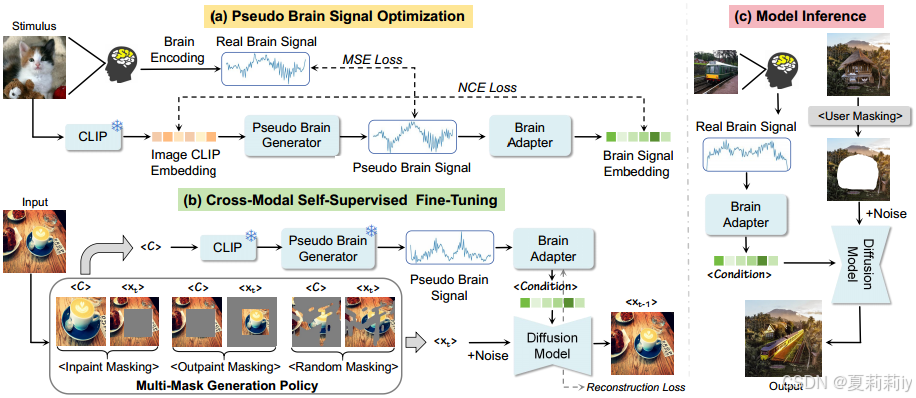
②For input , they get masked
and mask itself
③The pseudo-brain condition is obtained by
with Pseudo Brain Generator (PBG)
and parameter
. PBG is constructed by several residual linear layers
④Input: paired where
denotes brain signal with batch size of
and voxel of
, and
denotes image
⑤Fed to CLIP ViT/L-14, obtaining feature
with the shape of
. The loss is:
⑥Brain Adapter (BA) is a MLP (residual linear layers), process real and simulated brain signals and
to embedding
and
⑦Calculate the similarity matrix between two embeddings and employ CLIP constrastive loss:
⑧Loss of diffusion model:
⑨Probability of inpaint, outpaint and random masking: 0.5, 0.3, 0.2
2.5. Experiment
2.5.1. Dataset and Implementation
①Dataset: NSD for fMRI and image, OpenImages for image
②Test: random matching of 100 fMRI in NSD and 100 images in OpenImages
2.5.2. Qualitative Illustration
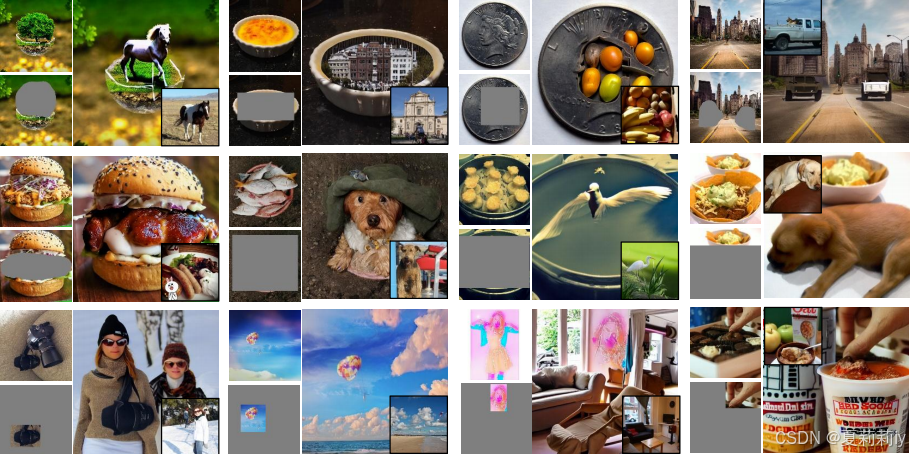
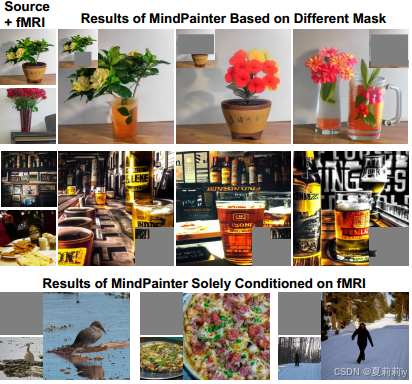
①Concatenation results:
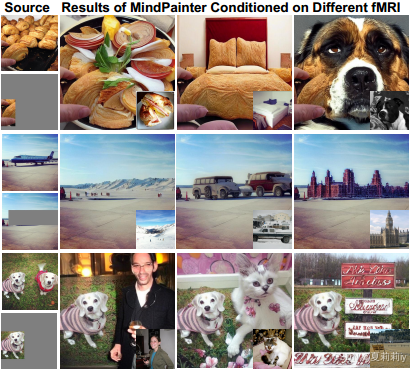
②The same image meets different fMRI:
③When mask all of the image, MindPainter will reconstruct image only rely on fMRI:
2.5.3. Comparisons
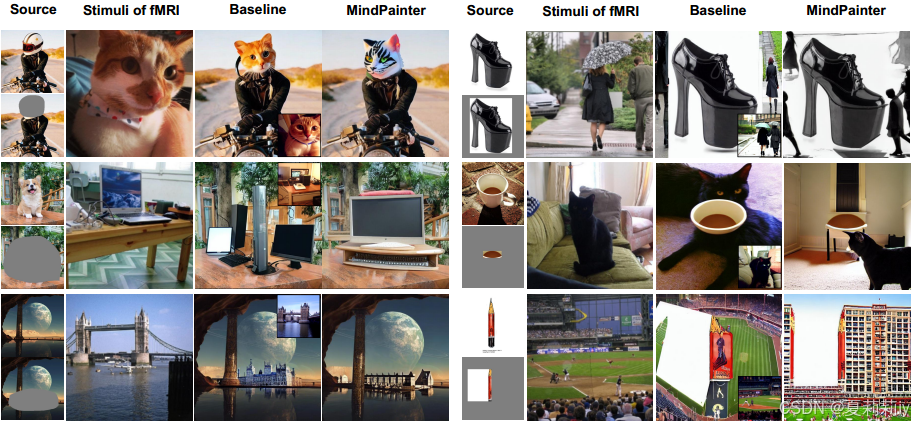
①Comparison:
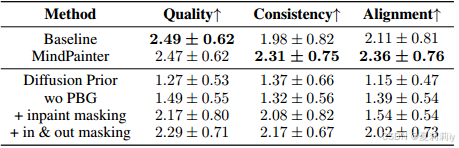
②Real evaluation on 1200 results of 20 reviewers (1 to 3, 3 is the best):
2.5.4. Ablation Study
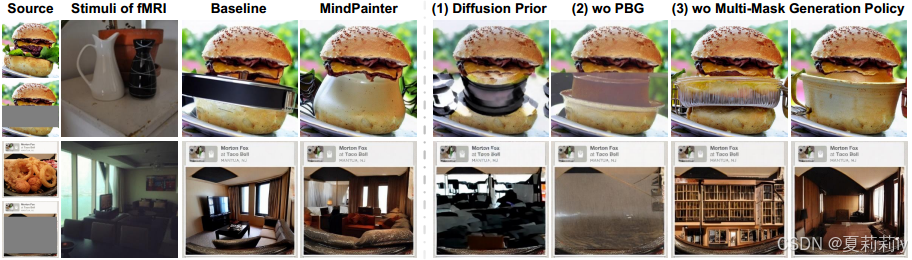
①Ablation results:
2.5.5. Effectiveness of Designed Modules
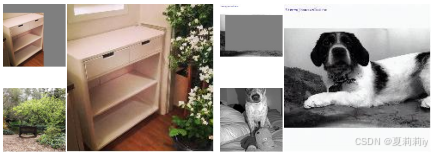
①The effectiveness of pseudo-fmri:
2.6. Conclusion
~

脑启社区是一个专注类脑智能领域的开发者社区。欢迎加入社区,共建类脑智能生态。社区为开发者提供了丰富的开源类脑工具软件、类脑算法模型及数据集、类脑知识库、类脑技术培训课程以及类脑应用案例等资源。
更多推荐

 12
12 0
0- 0


 已为社区贡献52条内容

所有评论(0)